
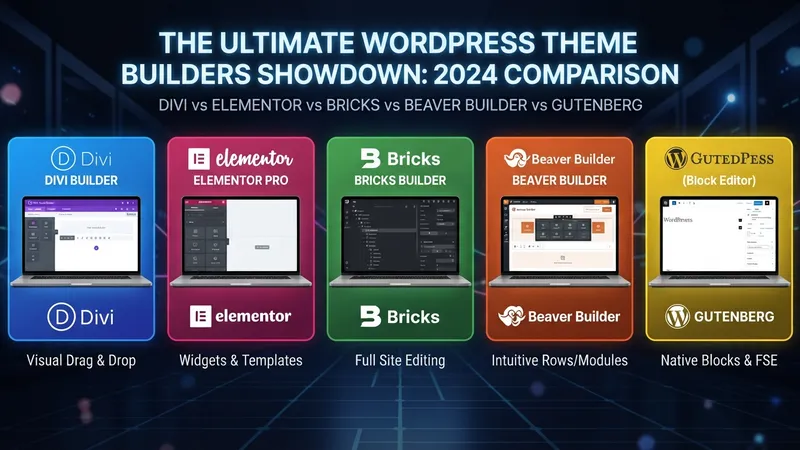
Five builders, and one question that decides between them faster than any feature table: does it build the templates around your content, or only the content itself?
Elegant Themes published a comparison of the five best WordPress theme builders covering Divi 5, Elementor, Bricks, Beaver Builder and the native block editor. Here's the version I'd give a client, including where the spec sheets mislead.
TL;DR: Divi 5 — best design flexibility, ~$89/yr or ~$249 lifetime, unlimited sites, theme building included. Bricks — leanest markup, one-time licence, steepest curve. Elementor — biggest addon ecosystem, theme building is Pro only. Beaver Builder — rock solid, but theme building is a separate paid add-on. Gutenberg — free and native, no visual header builder.
Page Builder vs Theme Builder
The distinction gets glossed over constantly, and it's the whole reason this category exists.
A page builder designs one page at a time. Great for a homepage or a landing page. Useless for the 400 blog posts that all need to look the same.
A theme builder designs the templates: global header, global footer, blog archive, single post, category and author archives, 404, search results, WooCommerce shop and product pages. You build the template once and every matching URL inherits it.
If a builder can't do the second thing, it can't build a website — it can build pages on a website. That's the filter to apply before reading any feature list.
The Comparison
| Builder | Entry price | Sites | Theme building | Markup weight |
|---|---|---|---|---|
| Divi 5 | ~$89/yr, ~$249 lifetime | Unlimited | Included | Much improved in 5 |
| Elementor | Free; Pro from ~$59/yr | 1 on entry tier | Pro only | Moderate |
| Bricks | One-time, around ~$199 | Unlimited on higher tiers | Included | Leanest |
| Beaver Builder | Pro from ~$199/yr | Unlimited | Separate add-on | Light |
| Gutenberg | Free | Unlimited | Site Editor, partial | Native |
Verify current pricing before buying. Every vendor on this list has restructured tiers in the last two years, and the numbers published in roundups go stale within months.
1. Divi 5 — Most Design Control
Around $89/year or $249 lifetime, unlimited sites either way. No free version.
The Theme Builder covers headers, footers, archives, single posts, 404, search results and Woo templates, with conditional assignment so a template can apply to one category and a different one elsewhere.
Divi 5's real additions over Divi 4 are structural rather than cosmetic. Design Variables make typography, colour and spacing global and reusable. The Loop Builder generates dynamic post displays filtered by category, tag, author or custom post type without code. The visual CSS Grid editor handles masonry and spanning items natively.
The bloat criticism was legitimate for a decade and Divi 5 answers it by rebuilding the front-end architecture, not by trimming features. It's now much closer to the lighter builders. What actually changed between Divi 4 and Divi 5 has the specifics if you're weighing the upgrade.
Best for: designers and agencies who want the most control, and anyone running more than two sites — the licence maths is unmatched.
2. Elementor — Largest Ecosystem
Free plugin; Pro from around $59/year for one site, up to roughly $199/year for 25.
The strongest third-party ecosystem in WordPress by a wide margin. Whatever niche widget you need, someone has built an Elementor addon for it. That matters more than any core feature comparison if your project has an unusual requirement.
Two things to know. Theme building requires Pro — the free plugin is pages only. And Elementor's addon ecosystem is also its performance liability: each addon loads its own assets, and a site with five of them is not a light site.
If you're choosing between these two specifically, the honest Divi 5 vs Elementor comparison goes deeper than a table can.
Best for: projects needing a specific integration, and teams already fluent in Elementor.
3. Bricks — Cleanest Output
One-time licence, around $199 for the tier most people buy.
Bricks is a theme, not a plugin, which is why its output is so clean — there's no host theme to fight. Native query loops, real class-based styling rather than per-element inline styles, and structure-first editing that developers consistently prefer.
The trade-off is honest and significant: the learning curve is the steepest here, and the editing model assumes you understand HTML structure and CSS specificity. Hand Bricks to a non-technical client and they will not touch it twice.
Best for: developers who want the leanest output and don't need to hand editing to anyone else.
4. Beaver Builder — Most Stable
Pro from around $199/year, unlimited sites. Beaver Themer sold separately, roughly $147/year.
Beaver Builder's reputation is deserved: it breaks less than anything else on this list, updates don't wreck live sites, and agencies who've used it for a decade rarely leave. Fewer features, all of them dependable.
The pricing structure is the catch worth flagging. Theme building is a separate product. Beaver Builder Pro plus Beaver Themer lands you well north of $300/year — for capability that Divi and Bricks include.
Best for: agencies who value stability over features and are already invested.
5. Gutenberg — Free and Native
The Site Editor handles templates and template parts. The Query Loop block handles dynamic post displays. theme.json and Global Styles handle site-wide colour and typography. All free, all core, no licence to renew and no plugin to abandon you.
What it still doesn't do is visual header and footer building in the way the paid builders do. You're editing template parts in a block canvas, which is functional and not the same experience.
For a straightforward blog or brochure site in 2026, this is genuinely enough. For anything with unusual layout requirements, it's a lot of fighting.
Best for: simple sites, tight budgets, and anyone who wants zero dependencies.
My Take: Template Library Size Is the Emptiest Spec on the Sheet
Here's my one strong opinion: "2,000+ premade layouts" is the most-quoted number in this category and the least predictive of anything, and I'd ignore it entirely.
I've built over 100 Divi sites. I've used a premade layout as a starting point maybe six times, and I have never shipped one. Not because they're bad — several are genuinely well made — but because a template is built around content that doesn't exist yet. Every real project arrives with a specific logo, a specific set of services, photography of variable quality, and copy that's either too long or hasn't been written. The layout survives contact with none of that.
What happens in practice is you import a beautiful layout, spend two hours replacing content, and end up rebuilding 70% of it while carrying the other 30% as structure you didn't choose. That's slower than starting from a blank section with a preset system you built. The one exception is using a layout pack as a structural reference — steal the spacing rhythm and the section order, then delete the import.
So when a comparison leads with library size — including the ET post this one summarises — treat it as a marketing number. The specs that actually change your work are whether theme building is included, how many sites the licence covers, and whether the person maintaining the site in a year can use it.
Two of these five make you pay extra for theme building. That's a real number. Two thousand layouts is not.
Choosing
One site, tight budget, simple design. Gutenberg. Genuinely.
One site, wants it to look distinctive. Divi 5 or Elementor Pro. Divi if you want the design tools included, Elementor if you need a specific addon.
Multiple client sites. Divi 5. Unlimited sites at ~$89/year is the only licence here that doesn't scale with your client count, and the lifetime licence maths gets more favourable the longer you stay.
You're a developer and nobody else edits the site. Bricks.
Agency, stability above all, already on Beaver. Stay. Just budget for Themer.
The question people skip: who edits this in eighteen months? A builder you love and your client's marketing hire can't operate is a builder that gets replaced. If you're weighing whether to build it yourself at all, what a Divi freelancer actually costs is the other half of that decision.
Straight Answers
Best theme builder in 2026? Divi 5 for flexibility and licensing, Bricks for clean code, Elementor for addons, Beaver for stability, Gutenberg for free.
Page builder vs theme builder? Page builders style pages. Theme builders create the templates — header, footer, archives, single posts, 404, Woo.
Is theme building always included? No. Divi and Bricks include it. Elementor needs Pro. Beaver needs Themer as a separate purchase.
Cleanest code? Bricks. Divi 5 closed most of the gap.
Lifetime licence? Divi (~$249, unlimited sites) and Bricks. Elementor and Beaver are annual only.
Can Gutenberg replace a builder? For simple sites in 2026, yes. It still lacks visual header and footer building.
The Last Word
Five builders, three questions. Does it build templates or only pages? How many sites does the licence cover? Who maintains this in a year?
Answer those and the choice usually makes itself. Ignore the layout count — it's the number in the brochure precisely because it's easy to make big.
If design control and unlimited-site licensing are what you're after, Divi 5 is the strongest position on this list. If you'd like a second opinion on which builder fits your project — including when the answer is Gutenberg and you should keep the money — that's a short conversation.
This is a summary of Elegant Themes' original post, "Best WordPress Theme Builders". All credit for the original content goes to Elegant Themes.